 OpenVisa
Inland or outland: which one should we pick, and can we switch?
One decision, made once, on the checklist.
Inland requires the two of you to live together in Canada, with the applicant holding valid status or covered by IRCC's out-of-status public policy; outland doesn't, and the sponsor can appeal a refusal, with some exceptions. You can't switch between them without withdrawing and filing again.
1. What do "inland" and "outland" actually mean?
Inland is the Spouse or Common-Law Partner in Canada class. Outland is the Family Class, processed by a visa office. The names describe the class, not where you are today: a couple living together in Canada can still apply outland.
A foreign national is a member of the spouse or common-law partner in Canada class if they (a) are the spouse or common-law partner of a sponsor and cohabit with that sponsor in Canada; (b) have temporary resident status in Canada…
So inland has two conditions: living together in Canada, and the applicant holding temporary resident status (visitor, student or worker, including maintained status while an extension is being processed). Under a 2005 public policy, a spouse or partner who is out of status only because they overstayed, worked or studied without authorization, or entered without a required visa or passport can still be sponsored inland (Guide 5289). Other kinds of inadmissibility aren't covered.
2. What changes depending on which one you pick?
| Inland | Outland | |
|---|---|---|
| Where the applicant is | Living with you in Canada, with status or covered by the out-of-status public policy | Anywhere, including visiting Canada |
| Work while waiting | Can apply for a spousal open work permit (SOWP) with the permanent residence (PR) application | A separate work permit application with its own rules |
| If it's refused | No appeal to the IAD. You can apply again or ask the Federal Court for judicial review. | The sponsor can appeal to the Immigration Appeal Division, with some exceptions. |
| Travel during processing | Leaving Canada is a risk to the inland conditions | Travel in and out is allowed |
3. We live together in Canada. Can we still choose outland?
Yes. Item 5 of the document checklist has a box for exactly this situation. Ticking it means you accept that an interview, if there is one, could be at a visa office outside Canada.
I am currently living in Canada, and I am applying under the Family Class … I understand that I may be convoked to attend an interview at a visa office outside Canada.
Guide 5289 points couples in Canada to the Family Class when the applicant doesn't plan to stay in Canada during processing, or when they plan to appeal a refusal (Guide 5289).
4. Can we switch after we've applied?
There is no conversion between the two. Switching means withdrawing the application and filing a new one, with new fees. The class is fixed on the day you submit.
5. On the form
You choose the class once, in item 5 of the document checklist (IMM 5533 for spouses, IMM 5589 for common-law partners).
When you sponsor a spouse or common-law partner, you must specify the “Class of Application” on the checklist you’ll submit.
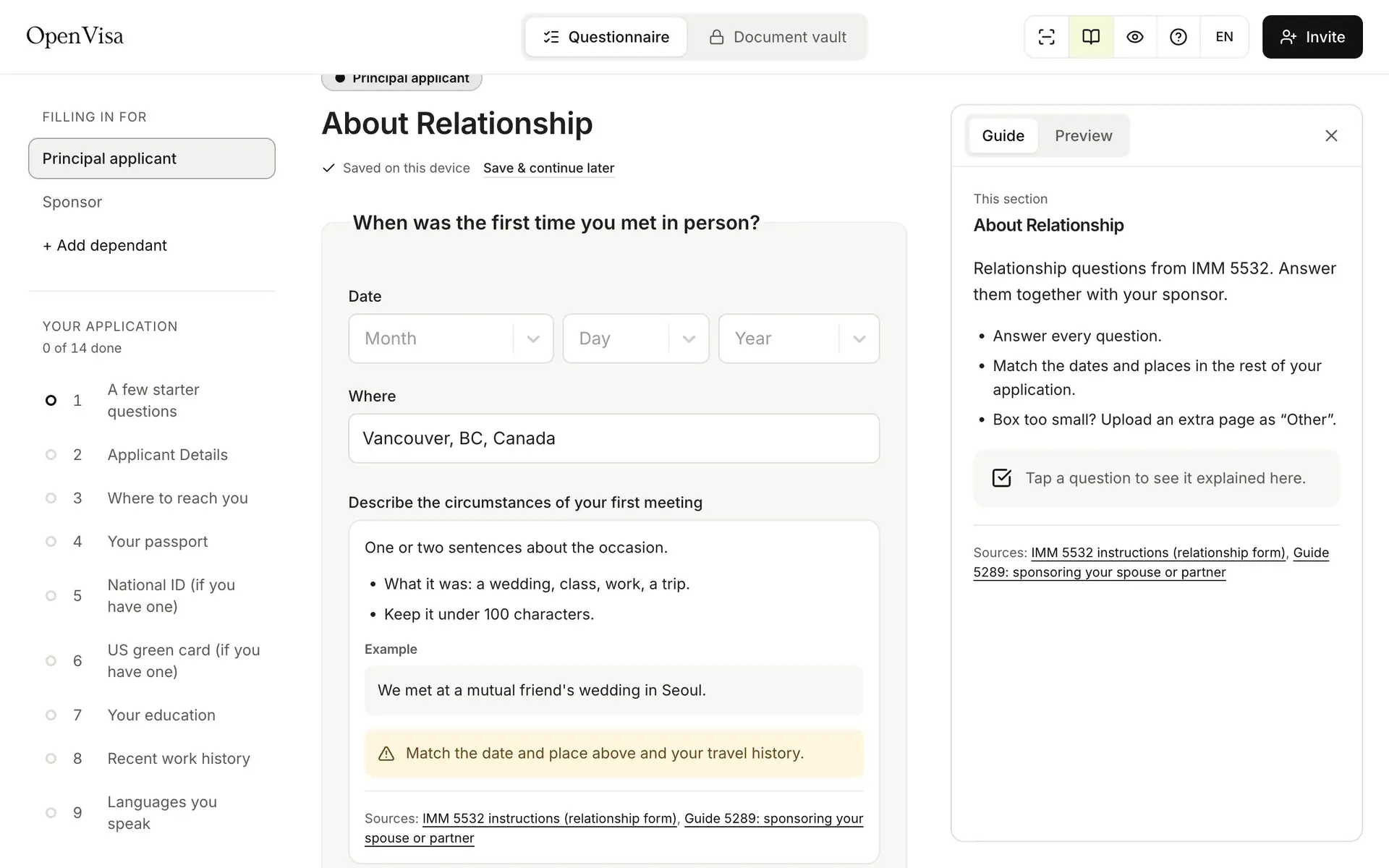
OpenVisa asks it as one plain question, with the guide beside it in 13 languages; you tick the matching box on the checklist yourself.
OpenVisa is software, not a lawyer or RCIC. This page explains what the rules and forms say; it is not advice about your case. You submit your application yourself.