OpenVisa

Spousal sponsorship, answered.

The questions couples ask every week about Canadian spousal sponsorship, answered with what IRCC says and what it means on the form.

32 answers, written from IRCC's own instructions and the regulations, and updated when they change.

Before you apply

Which class, who can sponsor, what common-law really means, what proof counts, and what to disclose.

16 questions
Inland · OutlandWhich one?
Inland or outland: which one should we pick, and can we switch?Where the applicant lives and whether you want the right to appeal decide it. Switching later means a new application.
Visitor in CanadaEither class.
Different risks.
My spouse is in Canada as a visitor. Inland or outland?Visitor status is temporary resident status, so inland is open while you live together in Canada. Outland is open too, and keeps travel and appeal rights.
StatusFile before
it expires.
My status expires before we can submit. What now?Apply to extend or change status before it expires and you keep maintained status while IRCC decides. After it expires you have 90 days to apply for restoration, with no status in between.
Sponsor eligibilityNo income
requirement.
Can I sponsor my spouse if I'm a student or my income is low?There is no income requirement to sponsor a spouse or partner. Of the disqualifiers, social assistance (other than for disability) is the one students ask about; student loans and a part-time job aren't social assistance.
Sponsor abroadCitizen: yes,
with a plan to return.
I'm a Canadian citizen living abroad. Can I still sponsor?Yes, if you show you'll live in Canada once your spouse becomes a permanent resident. A permanent resident living abroad can't sponsor at all.
QuebecTwo undertakings,
one order.
We live in Quebec. What's the extra step?Sponsors who live in Quebec also sign an undertaking with the Quebec government, after IRCC tells them to, and may face Quebec's own income rules.
Five-year bar5 years from
your own PR date.
I was sponsored myself less than 5 years ago. Can I sponsor now?Not as a spouse or partner. A person who became a permanent resident through spousal sponsorship can't sponsor a new spouse or partner for 5 years, even after becoming a citizen.
Common-law12 months,
continuous.
What counts as 12 months of cohabitation? Does time abroad together count?Common-law means living together in a conjugal relationship for at least one continuous year, anywhere in the world. Short trips apart don't break that year; moving into separate homes before it's complete does.
IMM 5589 · 7aLease. Joint account.
Same-address ID. Mail.
Common-law proof: what are the "two sets" the checklist wants?IMM 5589, the common-law checklist, asks couples who live together for proof of current cohabitation from at least two of six sets. The partner doesn't have to be a tenant; being listed as an occupant is enough.
Common-law or married12 months,
or the certificate.
We're not married yet. Apply as common-law now or marry first?With 12 continuous months under one roof you can apply as common-law now; if not, marrying lets you apply as spouses once the registered marriage certificate arrives. Marrying during processing is reported, not restarted.
GenuinenessThe test is real,
not typical.
Age gap, short relationship, met online: will IRCC think it's fake?None of those is a rule against you. The regulation asks whether the relationship is genuine and not entered into mainly for immigration; the evidence of a real shared life is what answers it.
EvidenceRange beats
volume.
What proof of relationship counts for spousal sponsorship: photos, chats, letters?Dated evidence across the whole relationship, from more than one source, within IRCC's limits of 20 photos and 10 pages of messages. Married couples who answer yes to all four questions in item 7 of IMM 5533 don't need to send more proof at this stage.
Proof of marriageCertificate,
not the record.
Record of Solemnization vs marriage certificate: which one does IRCC accept?Only the registered marriage certificate issued by the province or country. The Record of Solemnization you get at the ceremony is not proof of marriage.
Family membersDeclare everyone.
Examine everyone.
Non-accompanying spouse or child: what has to be declared and examinedIn this application, the applicant declares every family member and, unless exempt, has them examined, even those not coming. A family member who wasn't examined when someone became a permanent resident normally can't be sponsored by that person later.
Past problemsDisclose it.
ARC only with an order.
Previous overstay or refusal: do I need an ARC, and how do I disclose it?An Authorization to Return to Canada is needed only if a removal order was issued, and which kind decides it. Either way, the history is disclosed on the forms; leaving it out is the risk, not the history itself.
IRCC says“You don't need to hire a representative.”
Do we need a lawyer or RCIC?IRCC says you don't need a representative and that using one doesn't change how an application is treated. Only law society members, Quebec notaries and licensed consultants (RCICs) may charge for immigration advice.

The forms

What each box is asking, in the order the forms ask it.
10 questions
IMM 5532
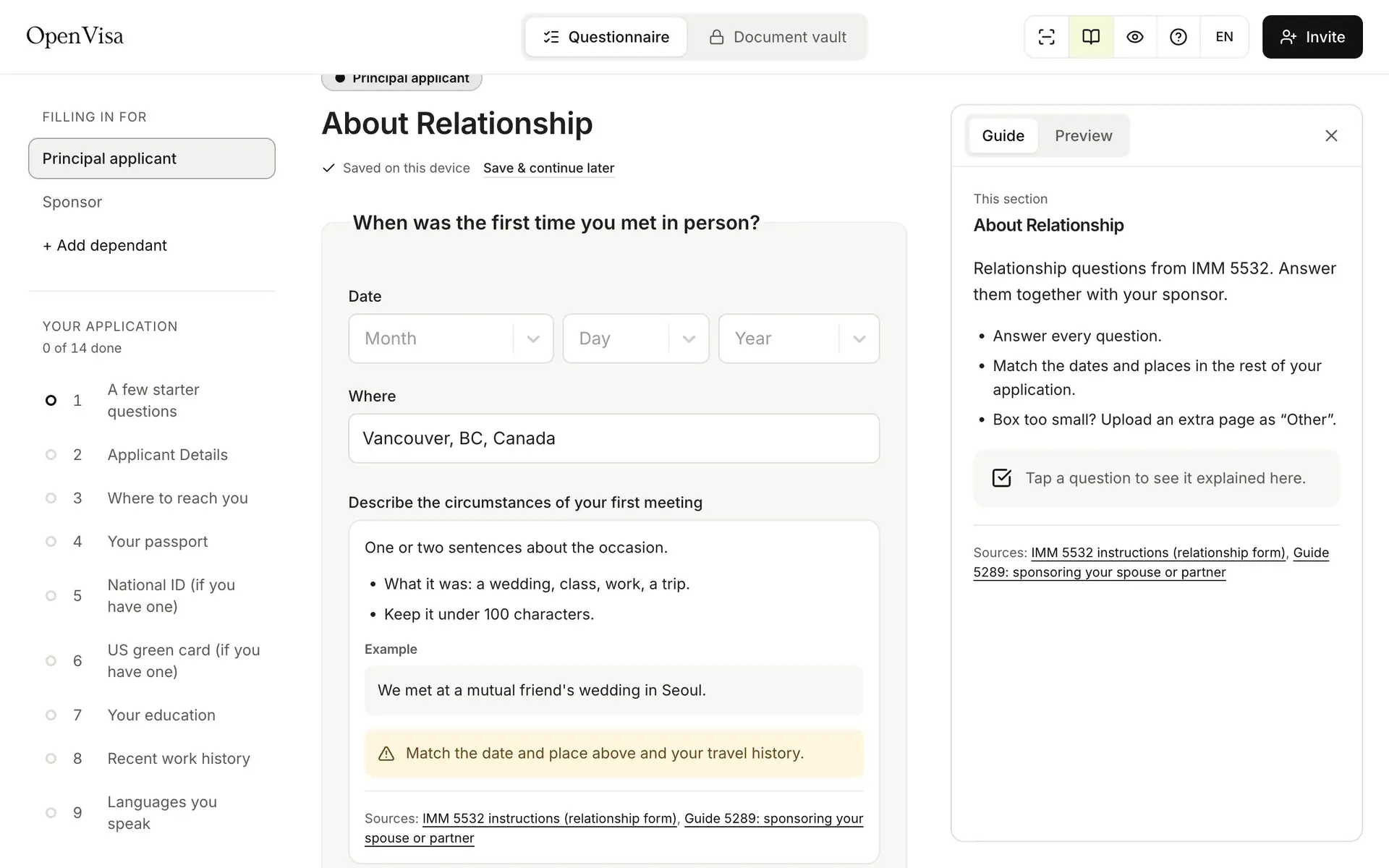
IMM 5532: what "how did you meet" is actually askingThe relationship form splits "how you met" into a date, a place and a short description. If you first met outside the applicant's country of residence, that date has to match a trip on IMM 5562.
IMM 5669 · AddressesMonth by month.
No gaps.
IMM 5669 address and employment history: 10 years, no gapsSchedule A asks for every address and every job, study period or stretch of unemployment, month by month, written out in full. Gaps and abbreviations are what get it sent back.
IMM 5562Every trip,
10 years.
IMM 5562 travel history: what counts as a tripEvery trip outside your country of origin or residence in the last 10 years. Short trips count, and "did not travel" when you did is what gets corrected later.
IMM 1344Residential:
where you live.
IMM 1344: mailing address vs residential address, and what if they differ?Residential is where the sponsor actually lives; mailing is wherever mail reliably reaches them. They can differ, and IRCC sends official correspondence to the contact details on file.
The packagePDFs to sign.
Portal forms to type.
Which forms are PDFs and which are filled in the PR portal?IMM 1344 and IMM 5532 are PDFs you fill, sign and upload with the document checklist, plus IMM 5476 if you use a representative. IMM 0008, IMM 5406, IMM 5669 and, if it applies, IMM 5562 are typed into the Permanent Residence Portal.
SignaturesFill. Print to PDF.
Then sign.
Digital signatures: why IMM 5532 or IMM 1344 comes back "missing signature"The fillable PDF has to be completed, then printed to PDF, then signed. Signing the live form, or typing a name in the box, is what gets it returned.
IMM 5409Not on the
spousal checklists.
IMM 5409: do we need it, who signs it, and what if we made a mistake?IRCC's current spousal checklists (IMM 5533 and IMM 5589) and Guide 5289 don't ask for IMM 5409. If an officer or a country-specific instruction asks for it, both partners sign it in front of a commissioner of oaths or notary.
Police certificatesProof you asked,
and a letter.
I can't get a police certificate from a country I lived in. What do I send instead?Proof that you asked the right authority, plus a dated letter explaining every attempt. IRCC says it can't guarantee acceptance, so the attachments matter more than the prose.
PhotosOne photo.
Studio receipt.
Photo specs, and where the "photo (back)" information goesOne photo per person, taken by a commercial photographer within the last 12 months. For a digital photo, the studio details that would go on the back are uploaded as a separate document under "Additional Supporting Documents, Other".
FeesCA$1,260
to IRCC.
Fees: what you pay IRCC, when, and what RPRF isAs of October 2026, IRCC lists CA$1,260 to sponsor a spouse or partner, paid online with the application. Biometrics are separate.

While you wait

Visits, work permits, travel and what to report once it's in.

6 questions
Dual intentVisiting is
allowed.
Can my spouse visit Canada while the outland application is in process?Yes. Dual intent lets the applicant visit while the outland application is processed, as long as the officer is satisfied the visit will end.
SOWPWho can work
while waiting
SOWP (spousal open work permit): who qualifies, and which SOWP you meanInland applicants with valid status can apply for an open work permit with the sponsorship, and some outland applicants in Canada can too. The permit for spouses of students and workers is a separate program, narrowed on January 21, 2025.
Inland travelYou can leave.
You must get back in.
Do I need to tell IRCC if I leave Canada during an inland application?Not for a short trip. The risk is re-entry: leaving can end temporary resident status, and if the applicant can't come back, Guide 5289 says a new overseas sponsorship application is needed.
After you applyWeb form,
with proof.
We moved. How do we update the address, and what else must be reported?Through IRCC's web form, with the application number and proof of the change. A new address, a marriage, a baby, a new passport and a change in the sponsor's situation all go the same route.
After you applyThe letter
sets the clock.
BIL and medical: when do they come, and is silence normal?The biometrics letter comes after you apply, with its deadline printed on it; the medical comes when IRCC requests it. Processing starts once IRCC has your biometrics, and neither step has a fixed date.
IMM 5533 · 5589Returned means
start over.
What gets an application returned as incompleteIRCC returns packages with anything missing rather than asking for it, and the months already waited don't carry over. The causes are a short list that repeats.
CHECKLIST FOR YOUR CASE

Two questions, one PDF: every form and document for your situation.

The checklist for your case (IMM 5533 for spouses, IMM 5589 for common-law partners) plus the country-specific documents, in the order you'll need them. One email. No newsletter.